


Rulewave
Warehouse Management System for a global logistics service provider
System ArchitectureCloud SolutionsSystem IntegrationAutomation Solutions

For operations where the warehouse, SAP and the carrier all hang on a single system. We build it, wire it into everything else, and stay with it for years.
Our partners





The vendor stopped developing it, or went away entirely, and the warehouse still runs on it. Every process change turns into a workaround.
SAP, the carrier and the scanners disagree about stock. Someone re-keys the data by hand, and the gaps surface at the annual count.
Unusual orders live in a spreadsheet next to the WMS. That's a problem, because they're often where the margin is.
Process first, code second. We start with how goods actually move through your warehouse, and design the system from there.
SAP, carriers, scanners, invoicing. One flow of data instead of a nightly export.
Intake, locations, picking, dispatch, cycle counting. The scanner shows the same stock the system does.
We stay with the system. We add modules as the business grows, and we pick up the phone when something breaks.
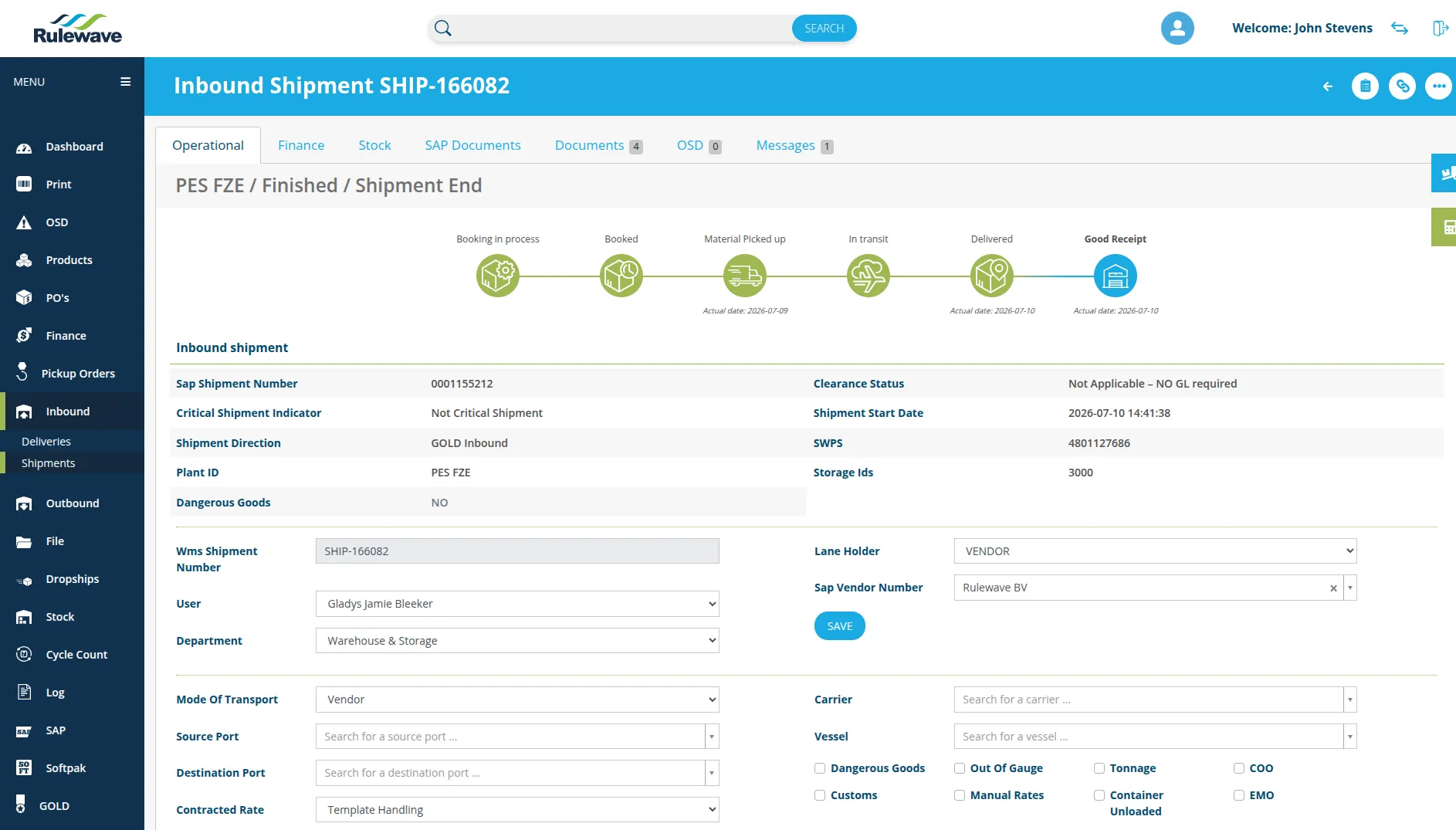
Rulewave is a global logistics operator. Their warehouse, supplier deliveries and billing all move through one system, which we built and still run.
Warehouse Management System for a global logistics service provider
Rewriting everything isn't always the answer. Often the cheaper move is to take over the system you already run and get it back under control.
| Build from scratch | Take over an existing system | |
|---|---|---|
| When it fits | Your warehouse process is the advantage, and the current system can't express it | The system works, but nobody is developing or fixing it any more |
| Where we start | With a map of the process on the floor | With an audit of the code, the database and the integrations |
| First result | One module in production, usually the process that hurts most | Fewer failures and releases back under control |
| Run-up | Longer, and you get a system shaped around your process | Shorter, and bounded by whatever we inherit |
| How the cost is framed | Against the cost of risk and downtime | Against the cost of carrying technical debt |
| What you're left with | Your system, and the partner who built it | Your system, and a partner who knows it |

No revolving door of contractors, and nobody disappears after handover.
Before anyone mentions technology, we walk your warehouse step by step.
We agree what goes to production first. Usually the process that hurts most.
The system goes live in pieces, alongside the old one, so the warehouse keeps running during the switch.
We stay with the system. When SAP changes an API, we answer the phone.
We start on the warehouse floor, with your process, not with screen designs. Then we agree the order: what goes to production first. The system rolls out in stages, alongside whatever you run today, so the warehouse keeps working through the switch. After that comes the long part: support and development, measured in years rather than months.
It depends on scope and on how many systems it has to talk to, so we quote after we've been through your process. Compare that figure with what an hour of warehouse downtime costs and how much time your team spends on workarounds today. That comparison, not the licence fee alone, is usually what decides it.
Yes, and it's a common way we start. We audit the code, the database and the integrations first, then tell you plainly what can be salvaged and what has to be rewritten. Sometimes the honest answer is that stabilising what you have beats rebuilding it.
We answer the phone and fix it. We've run the Rulewave system since 2019 and worked with that client since 2010. Changes on the SAP, carrier or regulatory side are part of support, not a new project to be quoted.
Day to day we work in English, in hours that overlap with Western Europe. Our turnover is low, so you deal with the same engineers year after year. The WMS we run for a global logistics operator handles external invoicing for the Netherlands and the US, so cross-border operations are familiar ground rather than a first attempt.
Tell us what's slowing the operation down. The first conversation is about the process, not the price.